
Berkeley County Deed Types and Transfers
A recorded deed is the instrument that documents a conveyance or other transfer in the Berkeley County land record. That is its whole job. The Clerk's public description confirms deeds online. It does not publish the vendor's complete instrument dropdown, though. The deed forms below are ones a researcher may encounter, and the instrument name, grantor, grantee and legal description on the actual record control how it reads.
| Deed Type | What It Does | Common Use |
|---|---|---|
| Warranty deed | Conveys the interest stated and may include title covenants | Ordinary sale or transfer |
| Quitclaim deed | Transfers whatever interest the grantor holds | Family transfer or title cleanup |
| Deed of trust | Secures an obligation against real estate | Loan or refinance |
| Fiduciary deed | Conveys land through an executor, administrator or trustee | Estate administration |
| Tax-sale conveyance | Documents a transfer after the tax process reaches deed stage | Delinquent-property proceeding |
A deed and a deed of trust answer different questions. A deed documents a conveyance. A deed of trust, lien or judgment shows a claim against the land instead. A release can clear that interest later. Search the release run too. The deed record proves only what was recorded, and never that no other claim exists.
Berkeley County Online Index Cutoffs
Each Clerk web collection starts in its own year. Online deeds begin in 1945, deeds of trust in 1918, liens and judgments in 1998, and releases in 1992. The cutoff tracks the instrument. A later release may clear an older debt. Likewise, a deed-of-trust entry can appear decades before the deed index reaches that same period.
| Instrument | Online Coverage | Older Search Route |
|---|---|---|
| Deeds | 1945 to present | Clerk land books, available in office from 1884 |
| Deeds of trust | 1918 to present | Ask Clerk for the prior book/index run |
| Liens and judgments | 1998 to present | Search at the Clerk counter and court as needed |
| Releases | 1992 to present | Request older land-book references in office |
The public page describes no search fields or sample rows. Assume no filter until you see it live. Start with a party name. Also pick a likely date range, so you can narrow the results before requesting copies. When you ask for a copy, cite the book and page or the document reference.
Berkeley County Virtual Courthouse Access
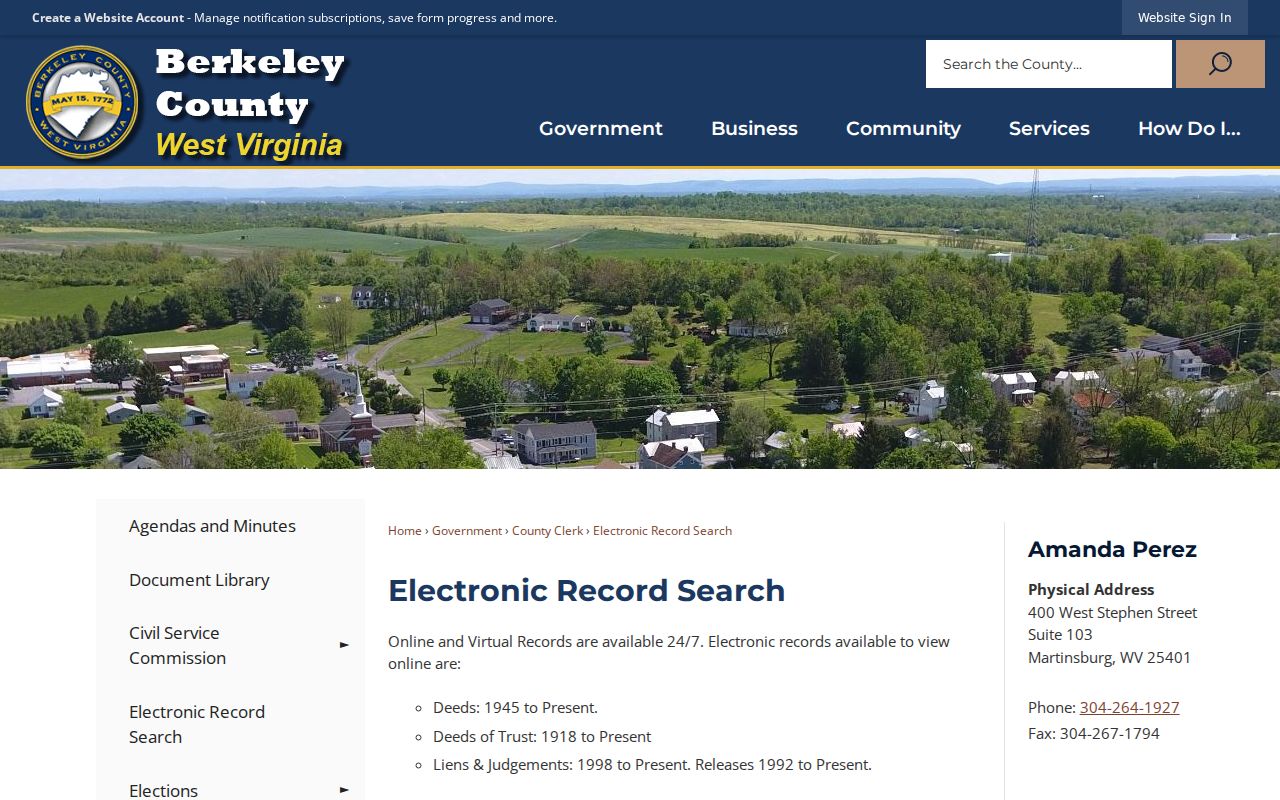
Virtual access runs 24 hours a day. It opens once the user agreement is complete. The Clerk creates accounts for regular use, with access expected within 24 hours during a normal business week. Weekends and holidays do not count. The service lists a $15 monthly charge. Pages cost $1.50 for the first two and $1 for each page after that. Copy requests go to the Clerk by phone, and the Berkeley County Clerk's electronic-record page sets out the coverage and virtual-account terms.
The public notice covers cost and access only. The Clerk publishes no separate fee schedule for in-office or certified copies, so ask about those rates before ordering.
The Berkeley County Grantor-Grantee Index
A grantor conveys the interest. A grantee receives it. To trace a Berkeley County chain, start with the current owner's acquisition deed. Note its parties, date, legal description and book/page. Next, hunt for that same grantor appearing earlier as a grantee. Then repeat until the date passes the known limit or the description no longer matches the parcel. The portal exposes no exact field labels, sorting or image behavior. Confirm each control as it appears live.
- Locate the latest recorded conveyance for the parcel and note its recording date, parties and legal description.
- Read the grantor name and search that party as grantee in the prior transfer.
- Compare the legal description and acreage at every step, including any split or lot/block reference.
- When the online run ends, take the names and date range to the Clerk’s in-office books.
- Grantor
- The party that conveys an interest in the instrument.
- Grantee
- The party that receives the interest.
- Chain of title
- The ordered links between recorded conveyances for a parcel.
- Book and page
- A record reference used to find an instrument in the Clerk index.
Old Berkeley County Deed Books Begin in 1884
Berkeley County property records start in 1884. That date beats the online deed index by decades. Not every book is indexed or imaged, though. The Clerk's office holds them. For a pre-1945 transfer, staff can pull the grantor and grantee indexes and the matching deed book. Come prepared. Bring current and former owner names, likely years, district/map/parcel, subdivision or lot/block, and any deed reference you already have.
Older entries hide behind name variants. Initials, married names and old place spellings were common, so search every plausible form. If the paper index turns up a likely deed, compare its description with the present parcel. Watch for acreage changes, easements or road rights-of-way. No courthouse fire or lost decade is on record. A missing web image therefore does not mean the underlying record is gone.
For an older transfer, note the volume, page, date, grantor, grantee, district and the exact wording of the tract. Deeds often cite an earlier instrument rather than repeat the description. That builds a chain of book-and-page references. Follow them in order. With a common name, test the acreage and adjoining-land references against neighboring instruments.
A parcel number may be absent from the original entry. Use the legal description to bridge the historic book to the current tax map.
Berkeley County Liens and Releases
Deeds of trust reach back to 1918 in the online index. Liens and judgments begin in 1998, and releases start in 1992. Search under the owner and also the lender or claimant, since Berkeley County indexes a lien against a party rather than a street address. A mortgage that was paid off can still show in the property records until a satisfaction piece is recorded. That is why the release series matters just as much as the original debt instrument.
Keep liens and taxes separate. A delinquent tax ticket is its own record, not a mortgage lien, and an unpaid balance does not mean the State Auditor has auctioned the parcel. For redemption, certification or sale status, turn to the Sheriff and State Auditor records; for a recorded lien or satisfaction, stay with the Clerk index. When a judgment or foreclosure filing ties to a recorded instrument, West Virginia Judiciary offers the state court entry point for the underlying case.
A docket tells the story of a proceeding. The recorded instrument supplies the land-record notice, so compare case number, party names and the parcel description across both before drawing any conclusion about a Berkeley County property.
Berkeley County Plats and Easements
The Clerk’s land records go beyond deeds. Plats, easements, rights-of-way and powers of attorney all sit in the same recorded property records. An older deed may carry no modern street address at all. Search by subdivision name, lot, block and original developer when those details are known. The recorded plat shows how a parcel was laid out. An easement or dedication can explain why the deeded tract differs from the mapped surface parcel.
County One Stop lists Minor Plat, Final Plat, Re-Plat and other planning categories. A permit or plan application is not a recorded plat, though. Check the planning file for review status. Then confirm the final recorded map with the Clerk. A GIS map viewer helps flag candidate parcels. But it cannot replace the recorded drawing or a survey in Berkeley County.
Probate Names in Berkeley County Deeds
Estate transfers rarely travel under one name. An executor, administrator or heir may appear in the deed records. They act in place of the decedent alone. The Clerk holds probate and estate administration files. The land index holds the instrument that actually conveys the parcel. Search the estate file for a fiduciary appointment or order. Then confirm the deed or court-approved sale in the recorded land trail. A probate appointment by itself is not proof that title changed hands.
Martinsburg’s older town lots and industrial parcels can also carry names that differ from today’s street labels. The B&O railroad reached Martinsburg in 1842. Interwoven Mills began in 1891. That history explains corporate grantors, rights-of-way and redevelopment plans. But each Berkeley County parcel still needs a matching deed, plat and legal description.
Getting a Berkeley County Deed Copy
The Clerk’s virtual account covers indexed online records. The office can still help with a copy request. The public page quotes $1.50 for the first two pages and $1 per later page, plus a $15 monthly user fee for online access. A $15 monthly user fee applies as well. No separate certified-copy or in-office fee schedule appears on the public page. Call the Clerk before relying on any copy price. Do not assume an online image is certified.
For older deeds, send or bring a focused request. Include party names, approximate years, and current and former street names. Add the district, map and parcel number, and the subdivision or lot and block. List any book and page already known. State whether you need inspection, an uncertified copy or a certified copy. The public page does not promise that the portal works as a title-search tool.
Identify the instrument by its recording reference before paying for anything. Confirm the county can supply the exact format you need. A web image, a plain copy and a certified copy differ. They are not interchangeable for every transaction. If a result runs several pages, capture the full deed with attachments and referenced descriptions. A partial image may omit the legal description or an exhibit that defines the property.
Recorded, not guaranteed. A Berkeley County deed record shows what was recorded, not every possible interest in the land. Use a title professional when the question requires an opinion about clear ownership.